Showing posts with label ethics. Show all posts

Friday, 1 February 2013

The morality of the press

This post is aimed at the Level 3 journalism students taking the Media Ethics modules (MAC373, MED312). It would seem that I haven't been given access to the module space in Sunspace yet, meaning that I can't add material, post content, respond to messages, etc...  In the mean time I'll post material here until I'm given the keys to the kingdom.

The week we are looking at the differences between morals and ethics in relation to professional journalistic practice. Radio 4 has a regular programme which quite often covers these issues so it's worth checking out the The Moral Maze, presented by Michael Buerk/David Aaronovitch.

In particular I thought I do is draw your attention to an episode that was first broadcast on 19th of November 2011 entitled 'The Morality of the Press'. It can be streamed in full from here. Here is the description that accompanies the specific show:

The Leveson inquiry into the culture and ethics of our press opened this week. In the wake of so many scandals has time finally been called on the industry that for so long has been drinking in the last chance saloon? Defenders of the press say any moves to impose external policing and regulation will threaten freedom of speech and undermine the vital role a free press plays in a democratic society. But why should we treat our press differently from any other industry that's key part of society? Broadcasting, energy, water - they all have external regulators. Is it still tenable to argue that the press is somehow different, special and should be exempt, when at the same time it operates within a climate that thinks it's acceptable to hack in to the mobile phone of a murdered teenage girl? And what about the noble calling of journalism itself? Has the financial pressure on the industry created a culture where ethics and morality come a poor second to doing whatever it takes to get a story that will sell? If we want to reset the moral compass of journalists is time for hacks to consider swearing the equivalent of the Hippocratic Oath? Or are we actually looking through the wrong end of the telescope. Do we get the press we deserve and are the people we should be questioning are those you buy, read and enjoy the stories that have prompted the Leveson inquiry? The Moral Maze - the morality of the press.

Combative, provocative and engaging debate chaired by Michael Buerk with Clifford Longley, Kenan Malik, Anne McElvoy and Matthew Taylor.

Witnesses:
  • Steven Barnett - Professor of Communications, University of Westminster
  • Ian Collins - Radio broadcaster - Formerly with TalkSPORT
  • Simon Jenkins - Journalist and Author, Former Editor of The Times and London Evening Standard
  • Rasmus Kleis Nielsen - Research Fellow at the Reuters Institute for the Study of Journalism, University of Oxford and Assistant Professor of Communications, University of Roskilde in Denmark.

Thursday, 7 July 2011

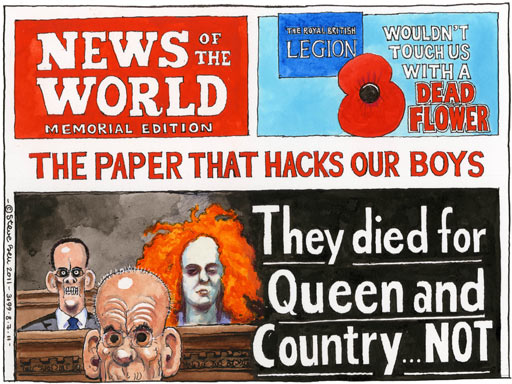
"Read all about it... News of the World"

The phone hacking scandal that the Guardian has been campaigning on for around 2 years (see Nick Davies investigative efforts from this point on) finally reached some kind of conclusion today with the announcement from News International that the paper is to close after its final edition this Sunday.  In addition to this former editor, Andy Coulson, is expected to be arrested tomorrow in relation to his knowledge of the paper's phone-hacking.

The paper has a long 168-year history, but it seems this is the end of the line, as Rupert Murdoch seems willing to sacrifice the best selling paper in the UK in a desperate bid to ensure that News Corp can make good on the purchase of the controlling stake in BSkyB (worth around $70 billion).  For many people, the position of the News of the World management had become untenable as more details continued to emerge regarding the hacking of phones belonging to child-murder victims (Milly Dowler), the families of the deceased 7/7 bombing victims, senior police officers as well as several high profile public figures. The stench of corruption might be too much for even this paper to come back from.

The cynic in me is still not convinced that the closure of the paper is being done for the right (moral) reasons.  It reads more like an attempt to draw a line under the affair in order to satisfy Hunt and the regulator that Murdoch and co are fit and proper people, capable of being responsible enough to own one of the crown jewels of broadcasting in Britain.  By closing down a profitable business, Murdoch is attempting to take control of the situation via a preemptive strike - drawing a line in the sand and praying that the accusations of corruption don't spread to his other UK-based publications (The Sun, The Times and The Sunday Times).  Murdoch's US publications seem rather restrained with regards to the detail they are going into on this matter (see the New York Post here and the Washington Post here)

This last ditch attempt to ensure the BSkyB deal can go ahead is typical of Murdoch - he has never been afraid of taking major risks in order to get what he wants.  The investment in Sky back in its early days was almost a risk too far, potentially jeopardising his entire empire.  However, that was a gamble that paid off in the long run.  Will this one work in his favour?  Can the chief executive of News International, Rebekah Brooks', position remain tenable given that she has been found culpable of 'editorial blindness and managerial ineptitude'?


Jeremy Hunt needs to take a good long look at the ethics that underpin the News International business model before arriving at his decision. This goes further than a concern about media plurality - the issue is now more about whether or not News Corp are fit to dominate so much of the British media landscape when they've been found wanting when it comes to telling the truth.

Wednesday, 12 November 2008

War reporting essay

I've been away a while... Work has been manic the past month but I thought I'd update the blog with some advice for those Journalism students taking MAC373: Media Ethics and Contexts, who plan on attempting the following question:
2. Habermas (2004) claimed ‘the critical state of a democracy can be measured by taking the pulse of the life of its political public sphere’. He also claimed ‘the public sphere serves those who have gained prominence as a stage for self-presentation’. How does the public’s right to participate in political life measure up against the journalist’s responsibility to serve the democratic process when considering sensitive stories?

A good answer is likely to consider the role and responsibilities of journalists in informing the democratic process. It may be advantageous to consider these issues against the backdrop of examples whereby the media appear complicit in preventing the public from accessing accurate information in a timely manner, for instance the news that Prince Harry was serving in Helmand, Afghanistan
Most of the material I have covered on the module to date has been informed by the core concern of democratic action within public life as informed by the media. Obviously, the work of Habermas on the 'public sphere' is important to this essay in that it serves as the theoretical basis for starting the investigation. Those students on MAC373 attempting this question will need to engage with Habermas' ideas in some form in order to complete the assignment.

I've posted copies of the slides used in the session on war reporting as a way of showing one way into the assignment:
Mac373 Reporting War 2008
View SlideShare presentation or Upload your own. (tags: war mac373)


You can find all of my presentations in the relevant folders in the MAC373 module space on WebCT Vista/Sunspace. I thought it might be useful for some of you to recap the ideas raised on MAC201 last year so I've included those slides here too:
News And The Public Sphere
View SlideShare presentation or Upload your own. (tags: mac201 news)

Tackling the essay

Some of the things that you are going to need to do in order to answer this question:
  1. Explain what is meant by 'democracy'
  2. Define the 'public sphere'
  3. Relate the 'public sphere' to the press/broadcasting (the role of 'public opinion'?)
  4. Consider some of the failings of the public sphere (is the press free from commercial concerns? do the public interact freely with news? do some voices/perspectives dominate the news agenda?)
  5. By this point in the essay, it should be possible to make some over-arching claims about the role the press plays in lubricating the cogs of democratic action
  6. The next stage of the essay should revolve around an example of your choosing - the only caveat is that the story or case study should be 'sensitive' in some way (ie politically or militarily dangerous, perhaps even concerned with privacy issues)
  7. You will need to engage with whether or not the public has a right to know or if the journalist/publisher/broadcaster has a right to withhold the information
  8. Is press freedom sacrosant?
The example you decide to touch on is up to you, but you might want to check with me first to ensure that it is substantial enough to suit the purpose. I have suggested that you might want to consider the example of the media blackout surrounding Prince Harry's 10 week tour of duty in Afghanistan, which leaked via the Internet. This is not the only example that you can use but it is an accessible one.

The story was thought to be subject to a DA-Notice in the British context as the mission was militarily sensitive, until the US-based Drudge Report picked up on an earlier Australian story and broke the news. At this point the British media opened up - there are lots of interesting newspaper accounts of whether the public had the right to know the whereabouts of the Prince, or whether or not it was prudent to not reveal his location for fear that it may endanger his fellow troops (see the links in the first slideshow above)

Was the Prince a likely target for the Taliban? Or was the stunt a PR exercise in order to raise troop morale? Did the media blackout even matter given the reports that the Taliban already knew Harry was there? Who really benefitted from the blackout? Prof. Roy Greenslade makes a few interesting observations in his Guardian blog piece here that you might want to check out.

You could also approach the question from a historical perspective. A famous example of when the British media dealt with a controversial story which might have been militarily sensitive can be seen in the This Week documentary entitled Death on the Rock. In 1988 the programme investigated an incident in which 3 members of the IRA were shot in Gibraltar by British special forces. Conflictual evidence led to public uncertainty about the legitimacy of the shootings. Did the public have the right to know?

You can watch the broadcast below:


Another famous example of a gag-order being served came in the Spycatcher case, when a former MI5 published sensitive information. The Times was carrying a story recently about a forthcoming book entitled Secrecy and the Media: The Official History of the D-Notice History by Rear-Admiral Nicholas John Wilkinson which was itself subject to D-Notice wranglings, and has been subsequently delayed by the publishers (Routledge). A couple of weeks back The Independent carried a story about palns to extend the powers of the DA Notice system, referring to a specific example

If you want to talk specifics then leave a comment or send me a plan or outline via email.